I was reorganizing my visited tabs (in SB, obviously) and found Outl, wich seems like an app to put in the radar, as it also supports Lua snippets with a > result: variable available to be embedded in Markdown. But is not extensible in Lua nor it have a desktop/web UI or something like Space Styles, so its extensibility story is pretty different.
If I remember well, I read a @zef's blog post, where he wrote about switching from Deno to Node and from Tauri to Electro, and there was also bout using also Rust in the back end. Maybe Outl's CDRT implementation can be interesting to look.
I think that, because of its web UI and Lua extension story all across the app, SB is more appealing to a wider audience and SB CLI can be used in contexts where Outl TUI can be interesting. As Zef said, PKM became a red sea, so having differential factors while keeping others in the radar is important.
Cool app, it just feels like the target audience is basically either people who care way too much about P2P, or people who haven't found SB yet
Interesting to keep track of where it goes in the future, though. It's funny to me how their marketing tries so hard to convey no-nonsense, but to me it achieves the exact opposite: at least compared to SB's website and docs.
I didn't see it like that when I read it, but not that you say it... totally agreed . The more interesting Outl part for me is its TUI and the replicating backend for multi device/user collaboration, event if such replication happens to be implemented with a server as some of the peers.
One of the things I like about SB is its "directness" and @zef's sense of humor (which are pretty complementary of each other). I'd say that SB's customizing scenarios are a strong selling point in the docs with Space Lua as a customizations enabler in UI and UX, while Outl compared with others (from LogSeq to Obsidian to Observable and Jupyter) calls the attention for those of use moving between note taking and interactive documentation and being used many of those tools in the past (as I said in my introduction, I would like to see a more complete interactive data notebook in SilverBullet as I think that have strong foundations for it).
More importantly, I'm glad to see how different PKM tools are exploring and/or converging over a more complete light syntax for hypertext/hypermedia (beyond basic Markdown), where transclusions, internal linking and scripting/customizations play a more central role. For example, how Outl and SB treat code snippets as more that just syntax highlighting and are an invitation to interactive exploration. I think that one of the first app to have this complete feature set was TiddlyWiki (2004) and, with the boom of PKM, more tools are including a similar set with different design/stack decisions. After using TW for years, and proposing notes + Lua + web as a more powerful/approachable combination for malleable PKM, I find myself pretty at home in SilverBullet in comparison with many other PKM tools, including Outl.
Which brings me to the how different tools offer this combination of relevance, friendliness and malleability to a wider and diverse community. In my experience with different tools, even the pretty malleable tools made in Pharo Smalltalk (including my own made), SilverBullet has a promise of unique value proposal in that front, as has been showcased on this forum several times.
I’ve actually moved from Silverbullet to Outl, and it’s been a much better fit for what I want out of a note-taking system. The biggest draw for me is the native mobile app. I used Silverbullet for months, and while the desktop experience is fantastic, the lackluster mobile experience led me to look for alternatives. I need to quickly open my notes, add a to-do, and put my phone away. Silverbullet’s PWA always took longer than I wanted, and the lack of a mobile toolbar or shortcuts made simple desktop tasks feel clunky. I also think and work in outlines often, indenting and outdenting bullets in mobile was essentially impossible for me.
Outl has a fantastic desktop app and all three platforms (desktop, mobile, and tui) have progressed substantially in the short time I've been using them.
I still check in on Silverbullet and think @zef has built a fantastic platform. There are several things I miss about Silverbullet, though. I loved that the configuration, plugins, themes, and, well, everything, were configured directly inside Silverbullet. It made iterating on plugin ideas, templates, or queries fast and fun.
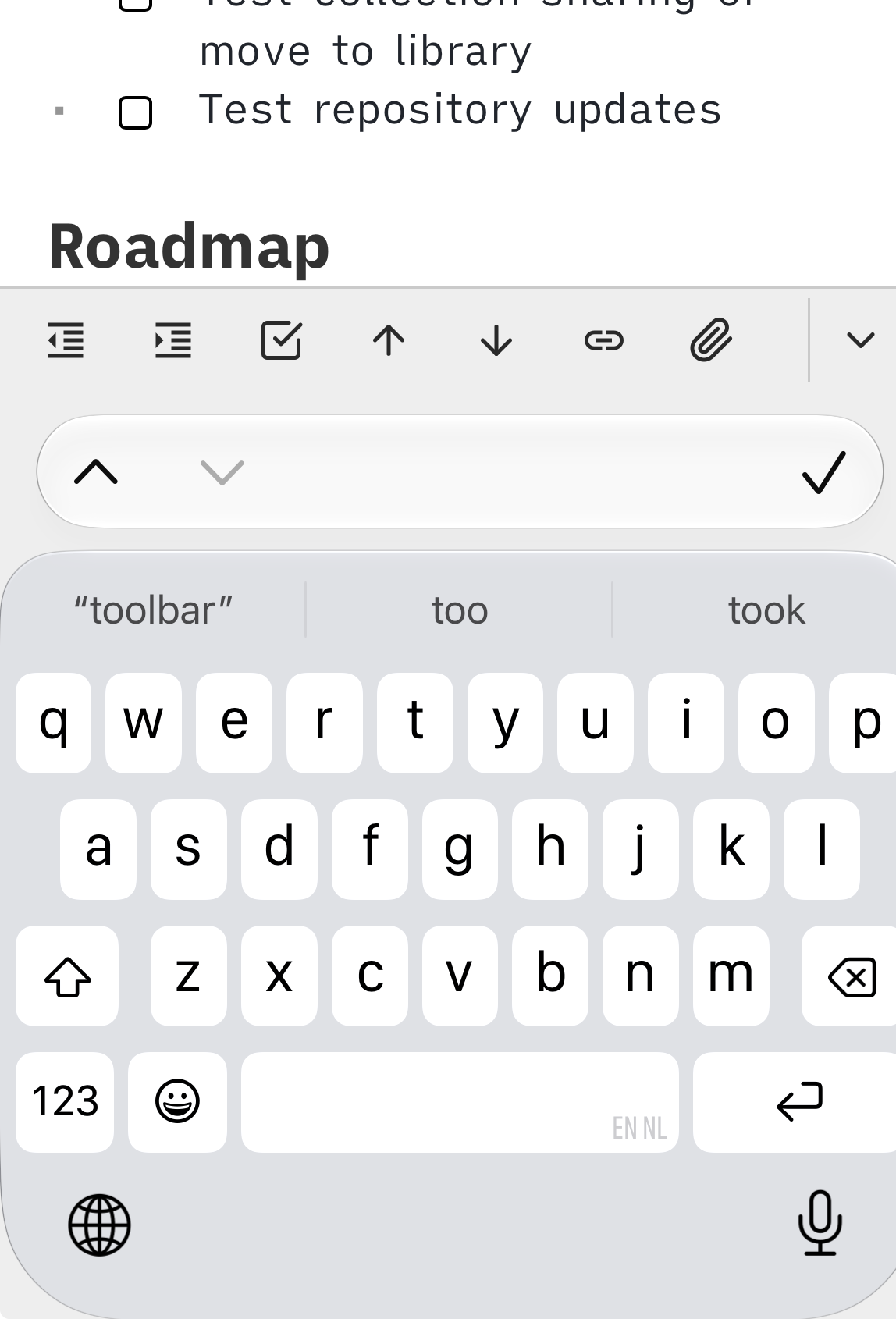
FYI: there is now a mobile keyboard bar that supports all the things you mentioned (indent, outdent, move up, down, turn into task/toggle, so you may want to give that a try it's been a game changer for me personally using this more on mobile.
Hi, I'm Avelino, outl's maintainer. Thanks for opening this thread, Offray.
@dtomvan, the point about the website copy is fair. Saying “no-nonsense” doesn't help if the text itself gets in the way of understanding the tool.
The thing I appreciate about SilverBullet is how Space Lua makes changing the tool part of using it, @zef congratulations on the excellent work you've been doing. frigidplatypus's point about configuring everything inside the notes captures that well.
Outlining, the TUI and native mobile apps are where outl fits some people's workflows. That doesn't make it a better fit for everyone, and this thread is a useful reminder of that.
Offray, your point about code snippets being more than syntax highlighting is worth exploring further. I'd be interested in what an interactive notebook in SilverBullet would look like for your actual work.
Thanks to you @avelino for mantaining Outl and for this conversation.
I think this malleability is the best feature of SiverBullet, as it fulfills several points of the malleable systems definition. Just to point two where SB does really well:
Modifying a system should happen in the context of use, rather than through some separate development toolchain and skill set
Computing should be a thoughtfully crafted, fun, and empowering experience
I have been exploring and building malleable systems with Pharo and Glamorous Toolkit (GToolkit), since 2014 when I made my own malleable outliner and I used to connect custom interactive documentation/publishing workflows for grassroots communities particularly regarding civic tech and data storytelling/visualization. It worked pretty well for us in particular contexts where we needed this, but I think that SB inserts better into the common day usage scenarios for a wider audiences by focusing in note taking as the default use case, and extending it from there with Space Lua. For me, this is a clever path in contrast with others which take a tool directed towards developers, like Pharo/GToolkit or VS Code/Codium and turn it into a more general note taking tool. In other terms, SB is simpler and more general, while still providing open extensibility thanks to Lua and the way it access SB's underlying web stack.
This is my case, as I use SB only from my laptop on a WUI (Web UI) from the localhost:3000 and the students/co-workers I have introduce it, use SB from the desktop app. When I'm away from my laptop, I mainly use paper notebooks as I'm more focused and less distracted with annoying notifications (I'm still thinking in how to combine analog and digital regarding note taking and tasks, but I don't think will be a mobile app... maybe a fanzine print with important notes and pending task...).
Most of the features I would like to evolve SB's UI/UX are in my introduction. So I'll quote from there to later elaborate a little case to go from what we have now, to what I would like:
I introduce computational thinking to undergrad students of Library and Information Sciences (LIS), now using Pluto+Julia (before I used Grafoscopio+Pharo/GToolkit). This usually means to do some API discovery/tranversal and some easy data visualization. So, I would like to port my educational material, starting with the Pluto/Julia interactive notebook for the PokeAPI to SilverBullet / Space Lua. This would allow to have something like:
function pokemonAppearenceFront(pokemonName)
  pokemonData = query[[
    from dataFrom(""https://pokeapi.co/api/v2/pokemon/" .. pokemonName)
  ]]
  return imageFrom(pokemonData["sprites"]["front_default"])
end
So, in a similar way to what we have now in Julia, calling pokemonAppearenceFront("pikachu") would return something like:
provided that the magical functions dataFrom(url) return a Lua table from a JSON response, that can be traversed with table notation and that imageFrom(url) takes a link and if such link is an image will return it into the page.
For PhD students, we work on how computational knowledge tools change the way we research and write/report. There I would like to evolve SB to support custom research workflows as I did with Grafoscopio, for example integrations with Hypothesis and Zotero and creating an queryable outliner (like the one in Leo Editor) to organize ideas, sequence and hierarchy when writing complex texts and evolve it towards the general UX/UI I described before. But I think that the first use case will suffice for now.

 . The more interesting Outl part for me is its TUI and the replicating backend for multi device/user collaboration, event if such replication happens to be implemented with a server as some of the peers.