What does your "Space Build" looks like? [Screenshots please]

From time to time we get to see a screenshot of some of your spaces and I always find it inspirational, so please post:

  • Screenshots of your index page (feel free to blur)
  • What libraries/plugs do you have installed?
  • Any custom libraries/scripts just for you?
  • Anything else of note?

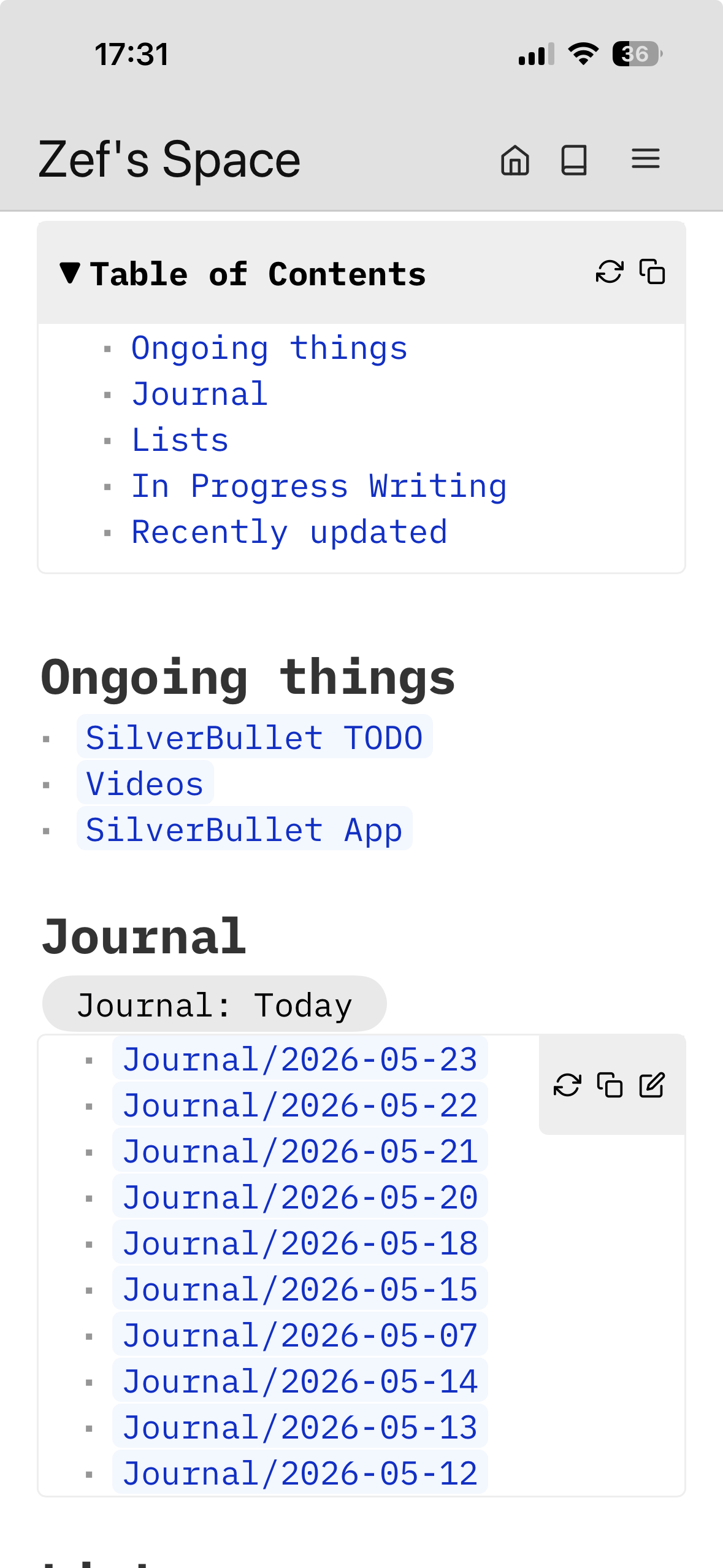
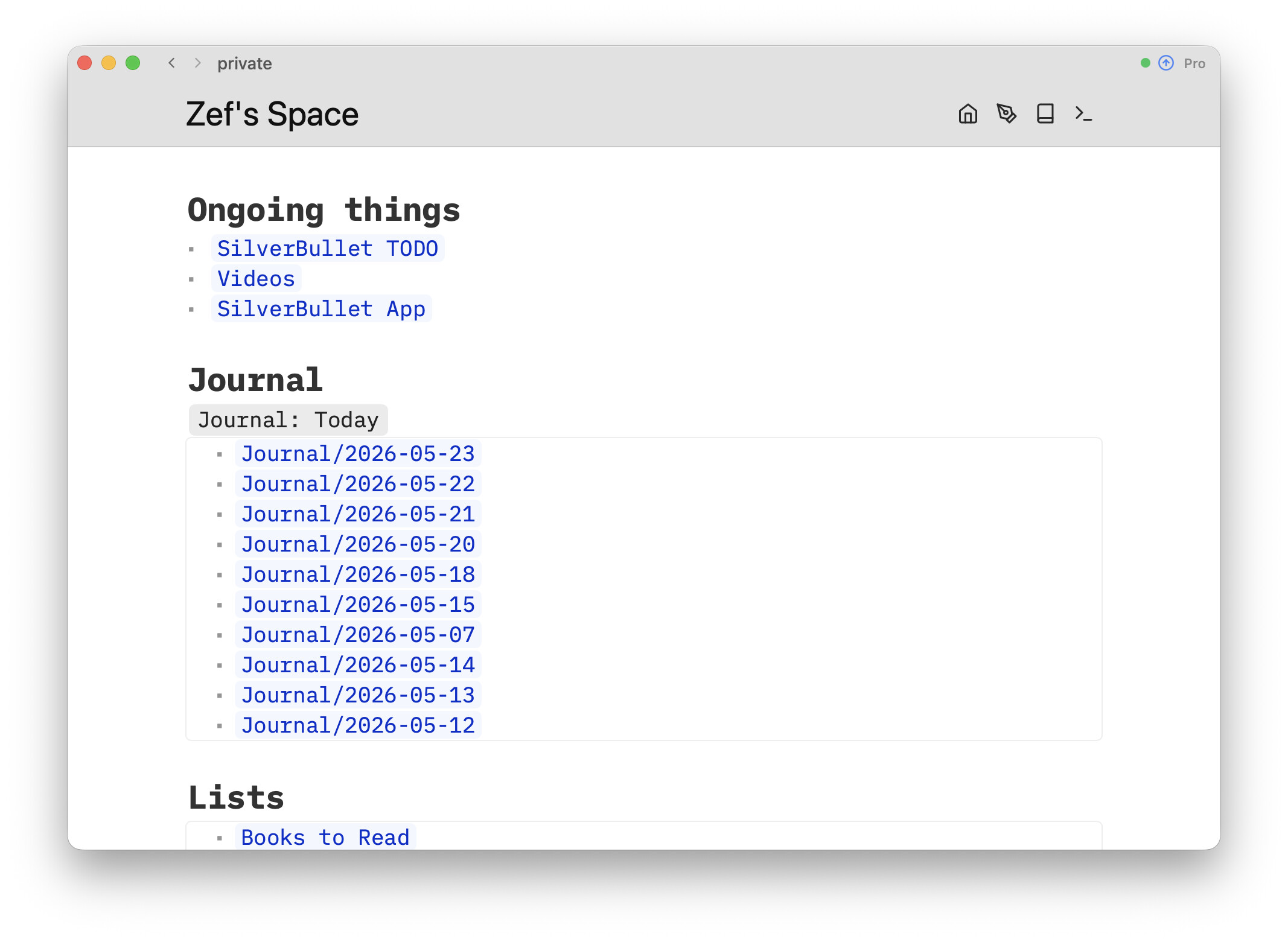
I'll start. In fact my index page is quite boring:

Of course, I'm using SilverBullet+ on the "edge" release channel as my daily driver, synced with my self-hosted server. Then I connect to that server directly (as a PWA) from iOS as well:

At the top: some of my most accessed pages. I basically manage my TODO for SilverBullet on a very messy page with a mix of tasks and "brain dump" sections.

After that: journal. I started taking notes primarily from my journal some months ago and really like this workflow.

Then I have a few lists, which are just pages tagged with #list I find this quite useful.

Libraries

Third-party libraries I use a lot:

  • Library/mrmugame/Silversearch
  • Library/zefhemel/Git (this is my backup strategy)

Notable CONFIG

actionButton.define {
  icon = "pen-tool",
  priority = 3,
  command = "Journal: Today"
}

To give me a "Journal" action button.

One perhaps interesting custom tag I use is bpm to note down blood-pressure measurements (I'm an open source developer, so I have high blood pressure):

local bpmPattern = "(%d+)/(%d+)/(%d+)%s(%d+:%d+)"
tag.define {
  name = "bpm",
  mustValidate = true,
  tagPage = "bpm",
  schema = {
    type = "object",
    properties = {
      sys = schema.number(),
      dia = schema.number(),
      hr = schema.number(),
      time = schema.string()
    }
  },
  validate = function(o)
    if not o.name:match(bpmPattern) then
      return "#bpm should match pattern: sys/dia/hr HH:mm"
    end
  end,
  transform = function(o)
    local sys, dia, hr, time = o.name:match(bpmPattern)
    o.sys = tonumber(sys)
    o.dia = tonumber(dia)
    o.hr = tonumber(hr)
    o.time = time
    return o
  end
}

This parses entries like this (sys, dia, heart rate, timestamp) in my journal in a structured manner:

* #bpm 120/80/70 17:36
In previous note-taking tools I avoided using one-file-per-day journals because I wasn't happy with any of the solutions for navigation and keeping context (I constantly need to see what I wrote last time). I like Logseq's Journal view which combines technically separate files into one scrollable view, but that admittedly adds implementation complexity and I didn't want to adopt Logseq for other reasons.

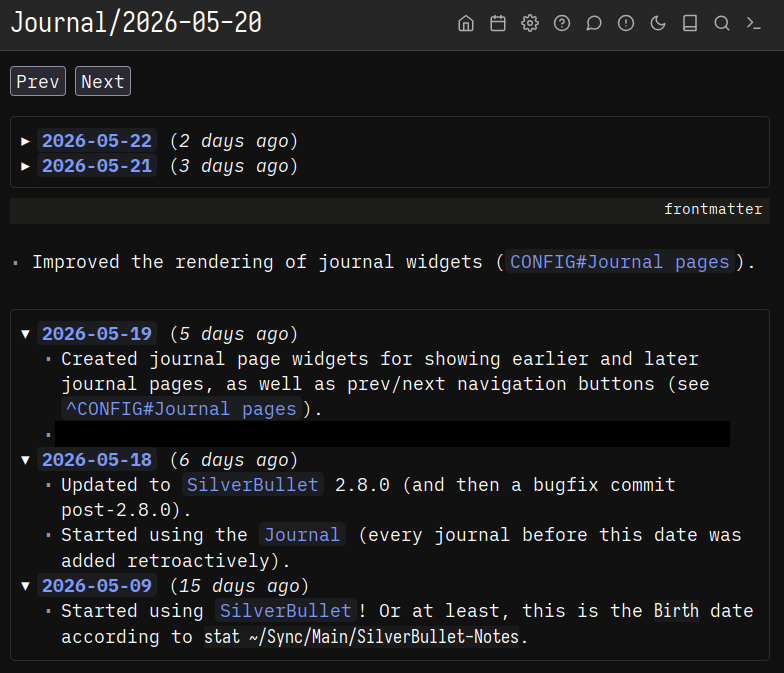
In SilverBullet I found that I can finally do one-file-per-day (and get the advantage of per-day Linked Mentions) by manually adding simple top/bottom widgets with a read-only view of surrounding days:

The Prev/Next buttons especially help on mobile. The quick-and-dirty code for these widgets can be found here. The frontmatter became more distracting after setting this up, so I borrowed this snippet from elsewhere on this forum:

/* Fold frontmatter down to one line when the cursor is not inside it. */
.sb-frontmatter.sb-line-frontmatter-outside:has(+ .sb-frontmatter) ~ .sb-frontmatter {
  display: none;
}

I am especially happy that I can have widgets that only show up for #journal pages and without any widget code being inserted in those files. In other apps I often found solutions that hinge on templates, but if you change a template, it doesn't automatically update the existing files. With top/bottom widgets you don't have to.


(P.S. Your #bpm tag is giving me ideas... bespoke note-taking shorthands that actually get parsed without resorting to external tools seem very handy.)

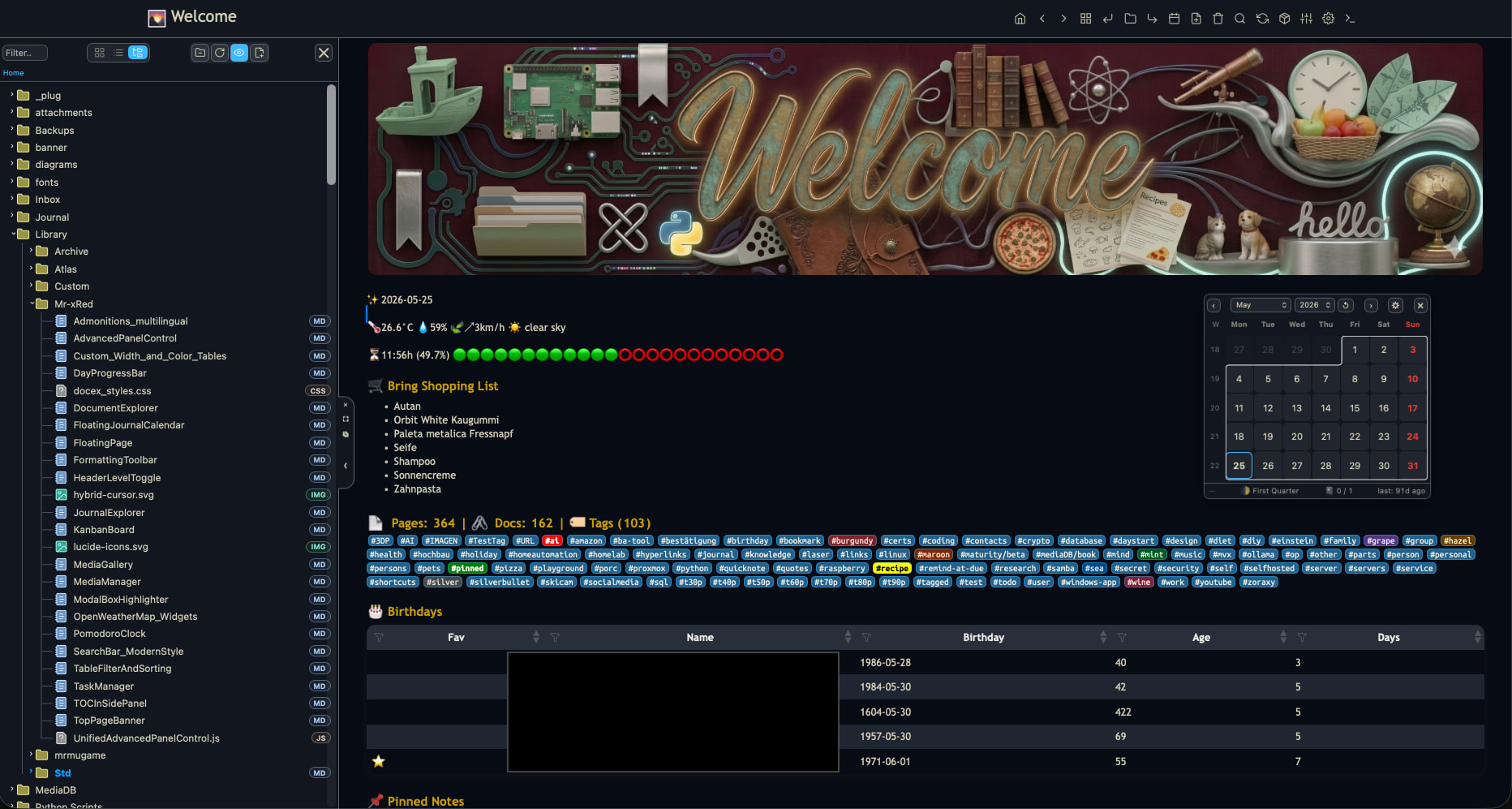
Here is mine.

the DocExplorer and Journal Calendar is not always visible, I just toggled it on to show off :stuck_out_tongue:

Hi!

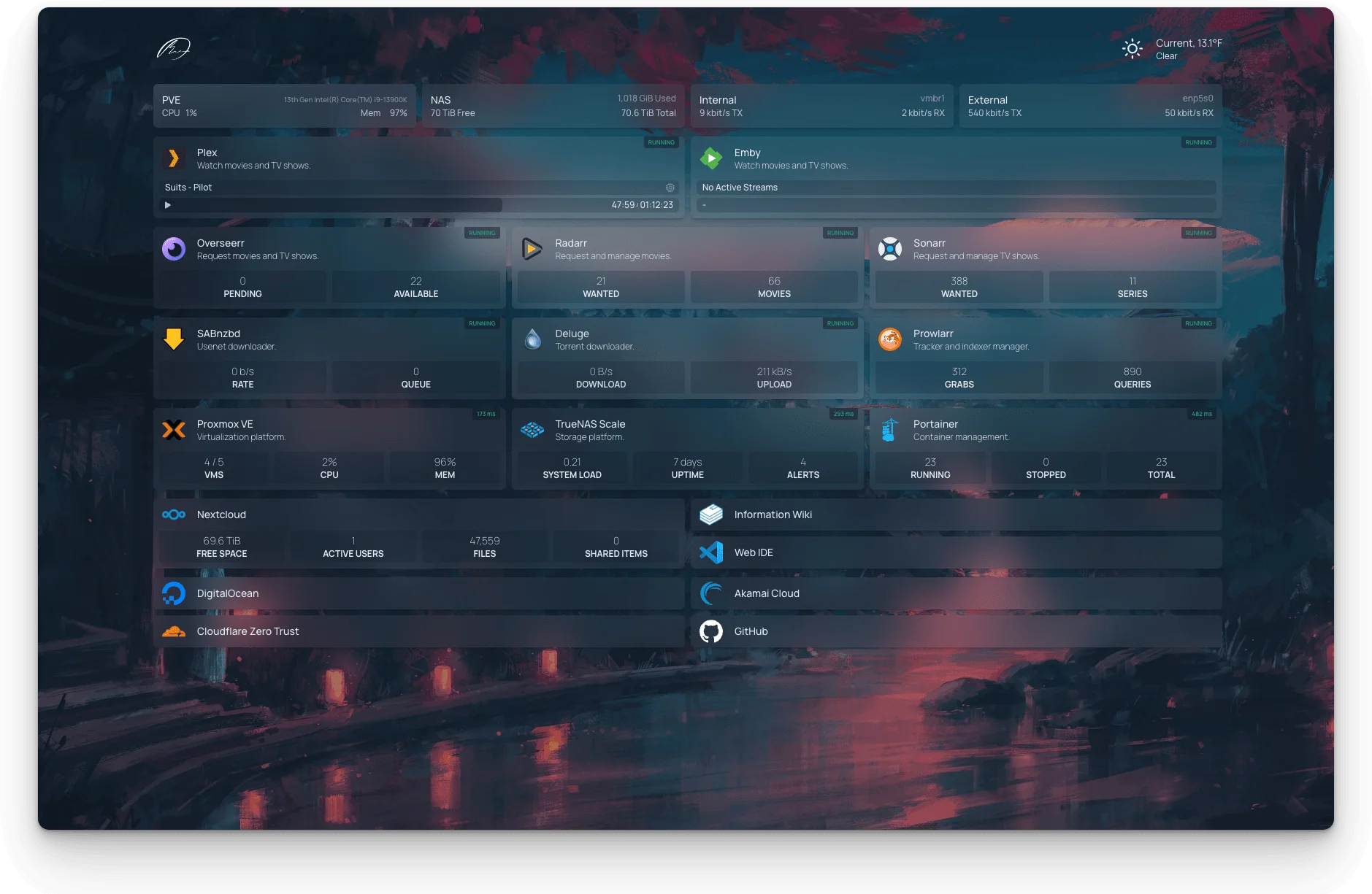
Not able to share yet, but I'm planning to change my homepage dashboard (similar to this https://gethomepage.dev/assets/homepage_demo_clip.webp) to a small silverbullet space.

With silverbullet will be easy to provide a dashboard with options to navigate by internal subdomain, server name or IP in a simple and customizable ways.

Starting with a simple widget by apps groups, and then moving to something nice inspired on this:

Hi!

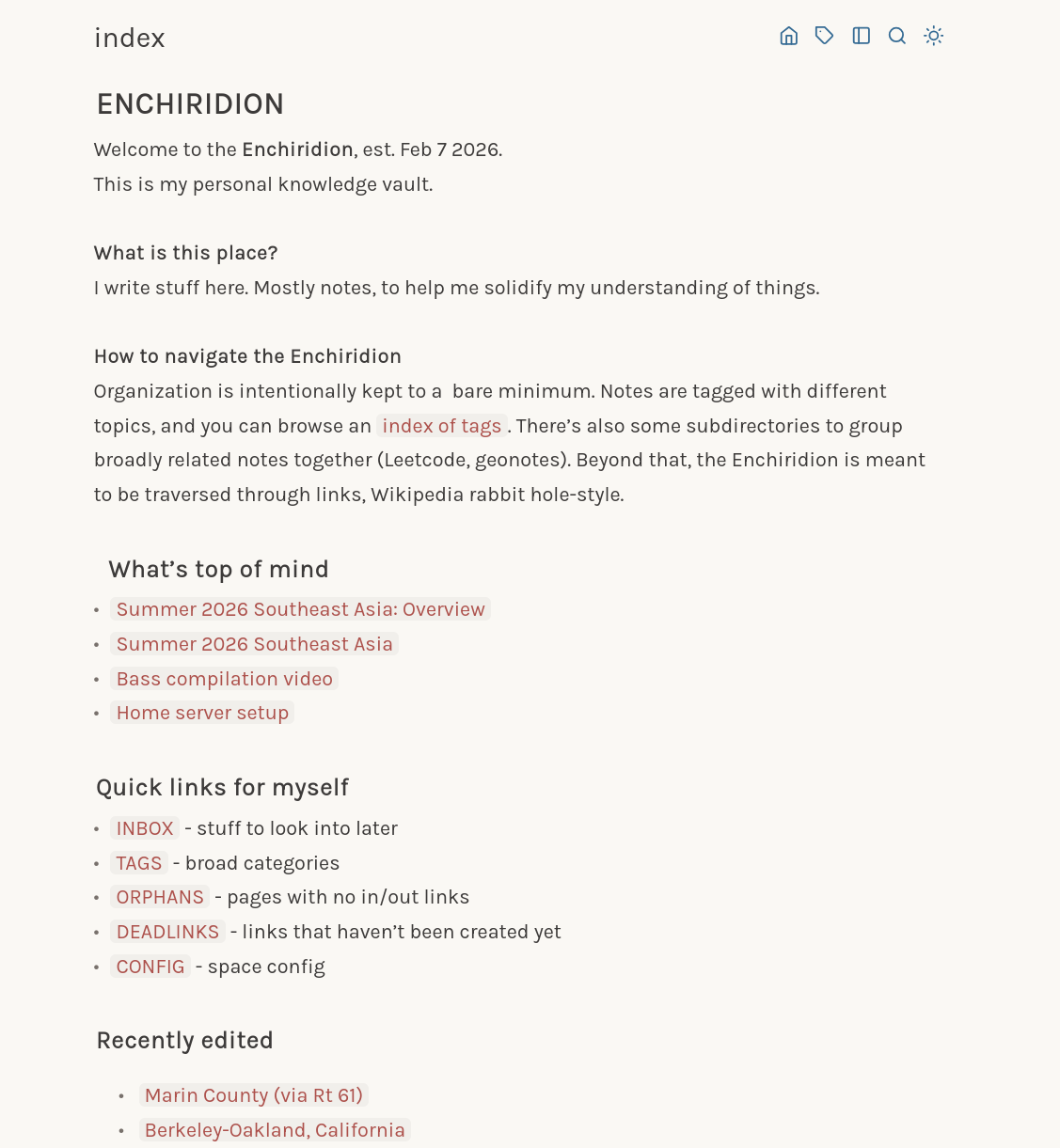
Here is my index page, pretty barebones.

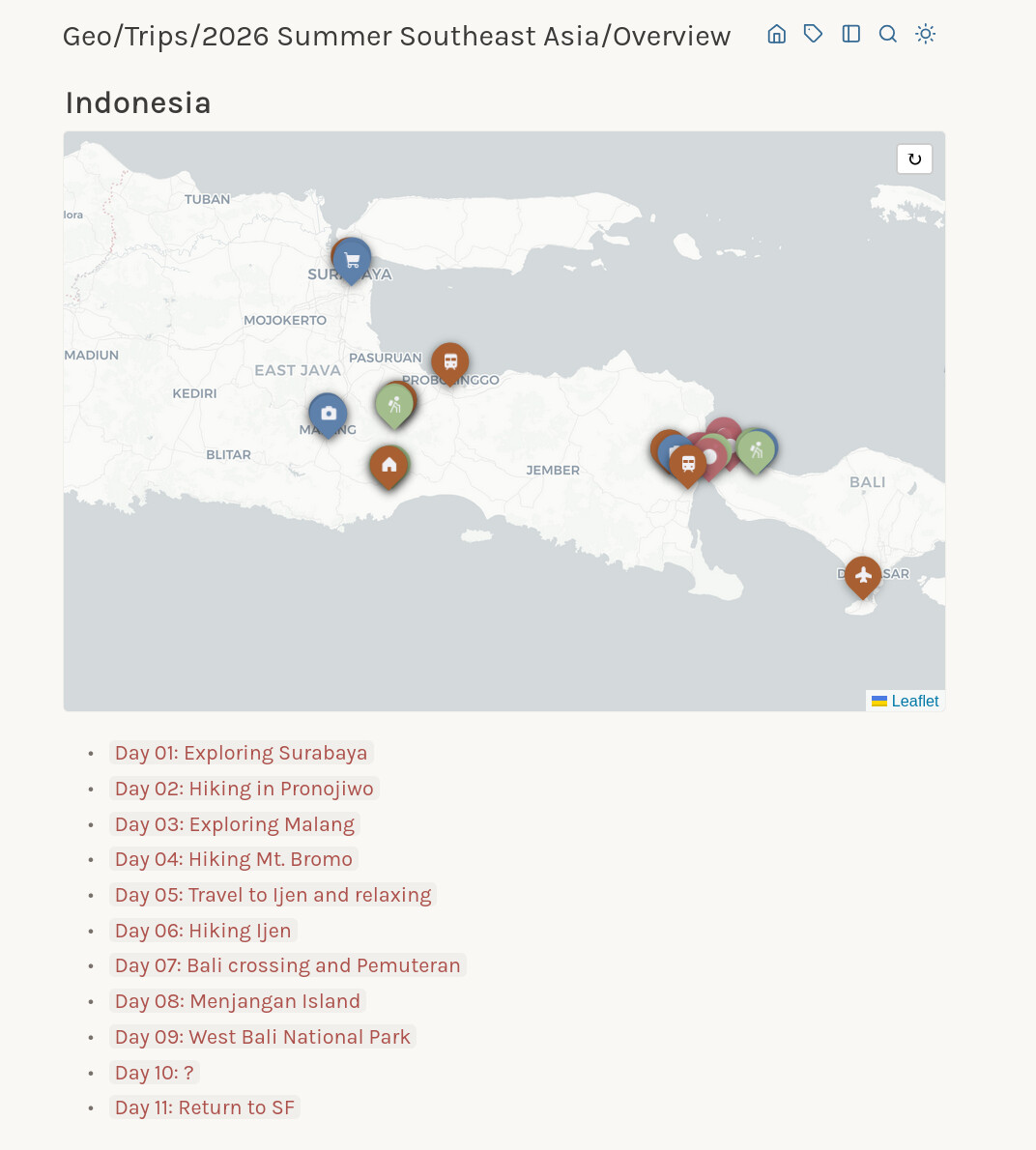
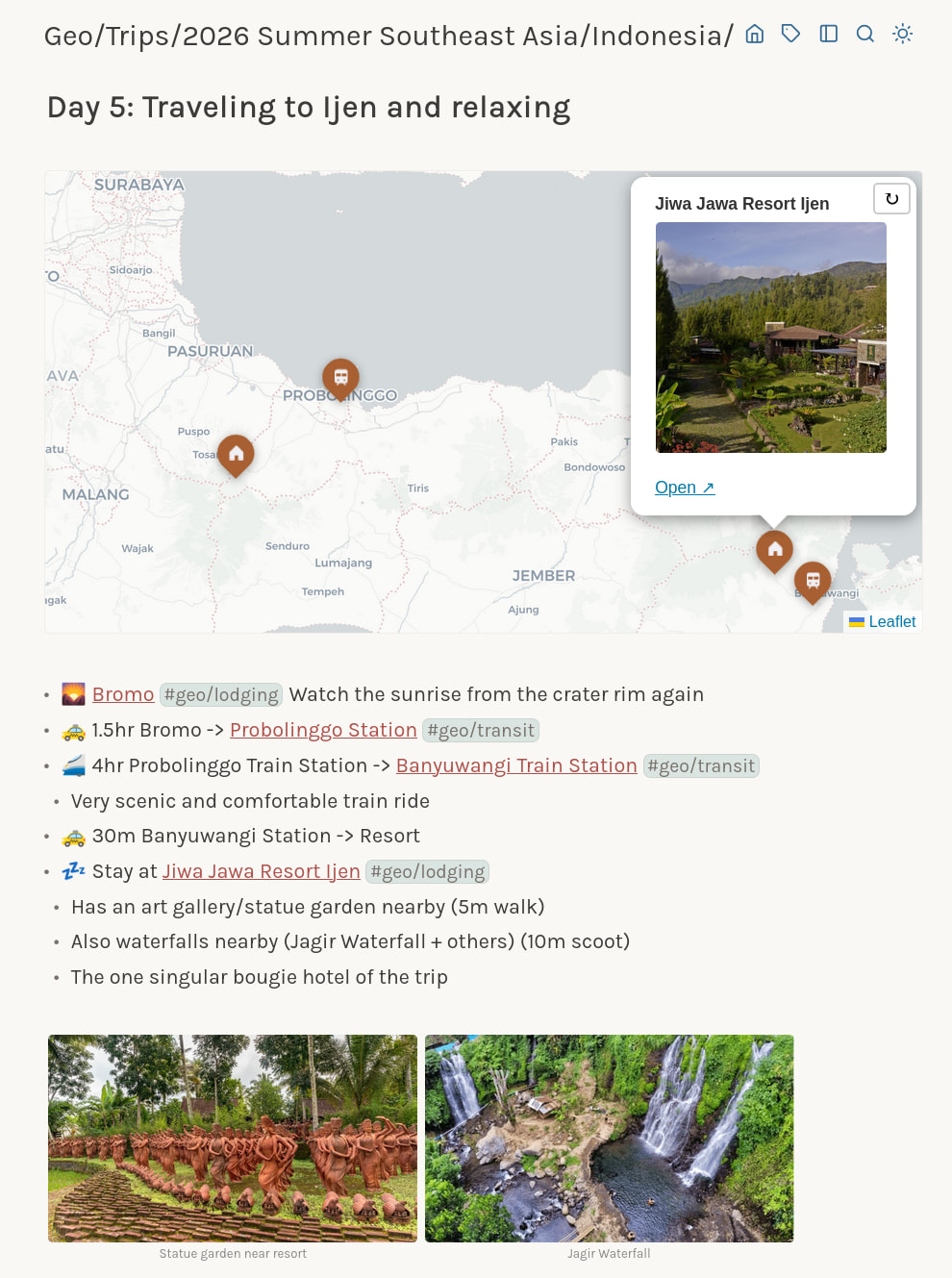
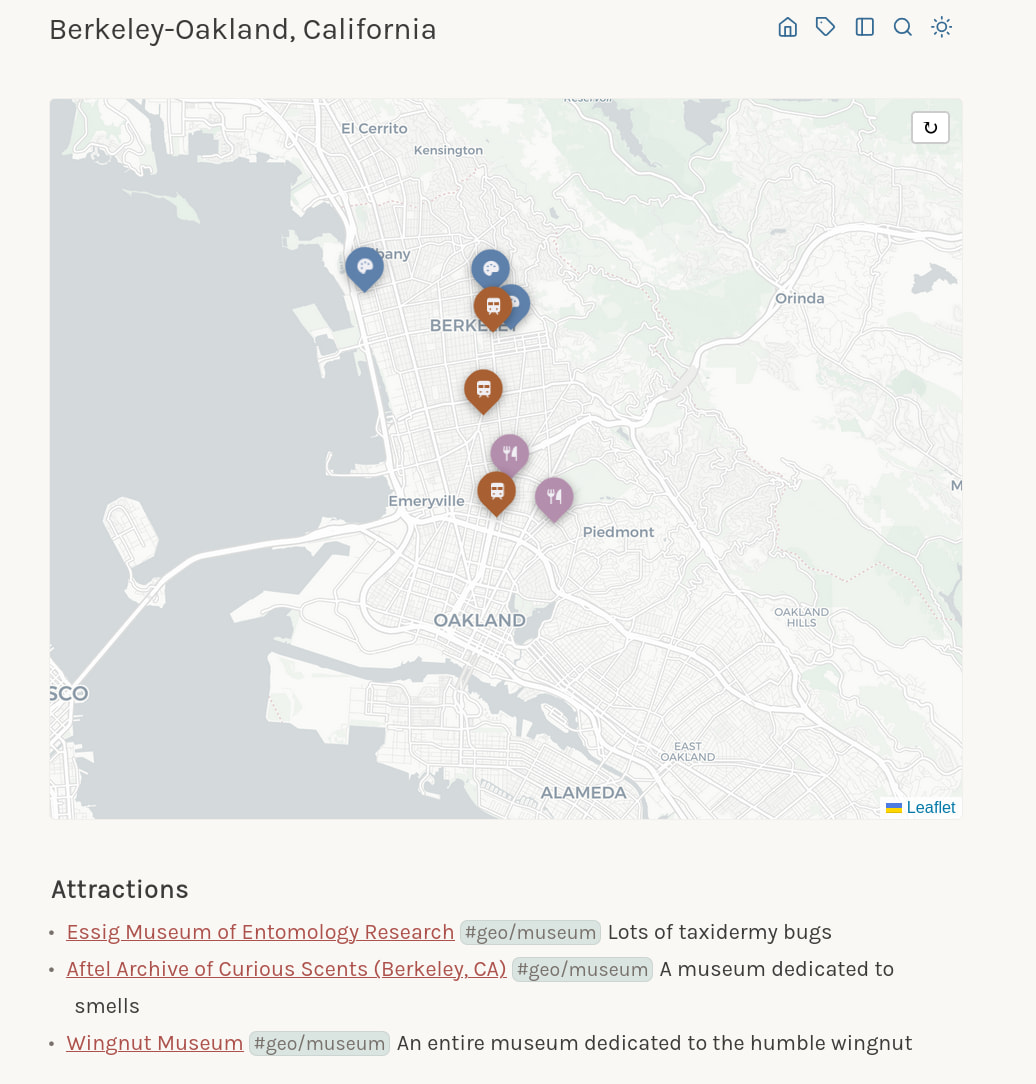
On custom libraries - I migrated from Obsidian and used to use the Obsidian Map View plugin heavily for travel planning and recording other geolocation notes. I cobbled together a rough equivalent for Silverbullet and have been pretty happy with it so far. (There's still some bugs but you can take a look here if you are interested.)

I even set up a read-only instance of my space and made it accessible with Cloudflare Zero Trust so my family can view these travel plans as well!

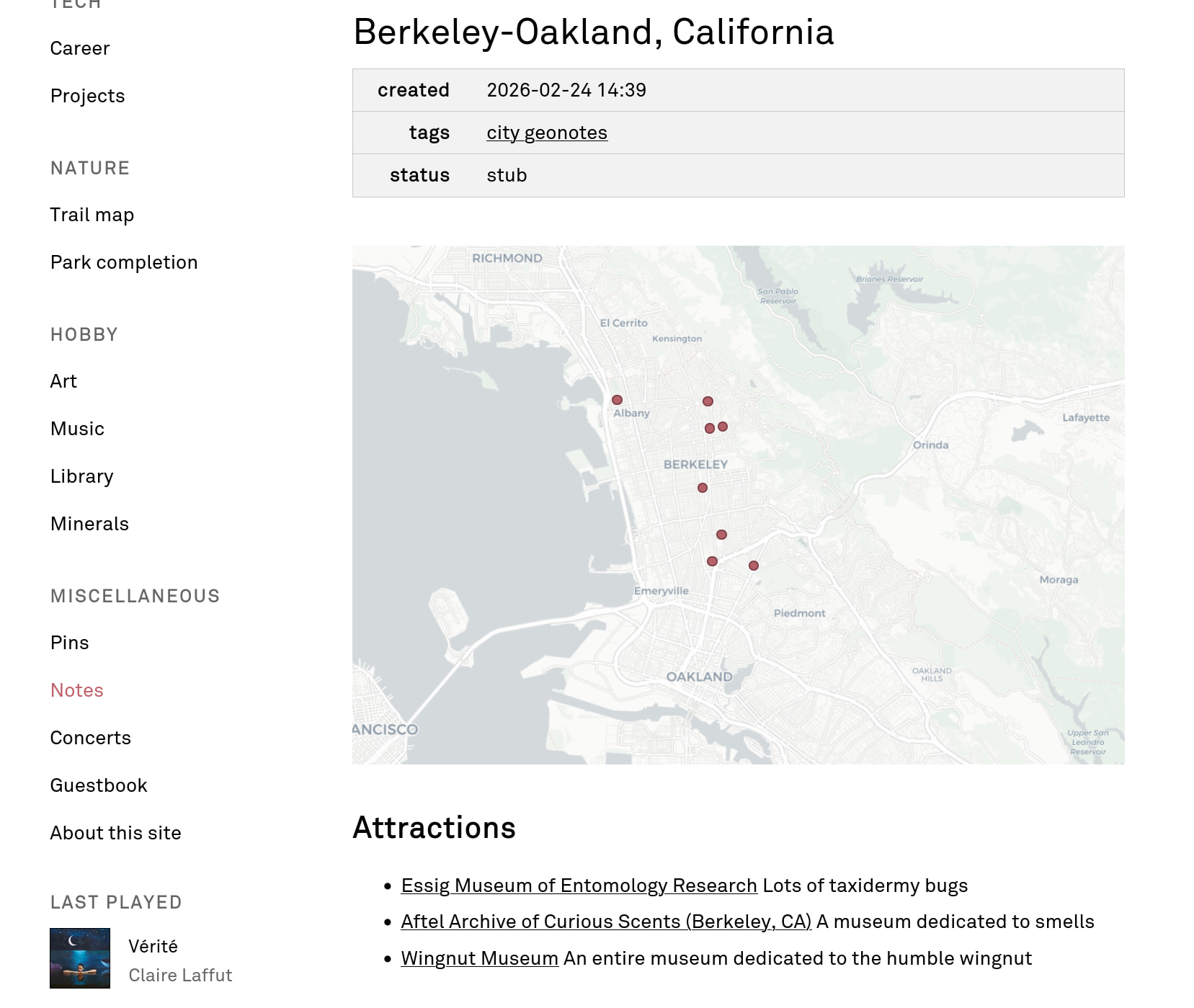
Semi-related, but here is another fun thing I've done recently - I really like Silverbullet for editing and viewing my notes, and I wanted to share some of my notes publicly since I take them "digital garden" style. However it bothered me that the Silverbullet site was so visually different and separate from my existing personal website (which is made with Hugo), so I made an insanely overcomplicated custom Silverbullet markdown -> Hugo markdown auto conversion script to get my SB notes on my site. The result is pretty good!

I would be curious to see your CSS and how you make the fonts and layout look so nice. Great looking pages.

Hi. During last days I was "de-coupling" my spaces on several docker containers.

As overal rule, I try to keep a few buttons on each home plus the main actions or information I want on each specific space.

I wanted to share a videos of some of my spaces (to follow-up on other post).

  • Foods home page (and common actions)

  • Workout space

  • Journal space...inspired (and copied!) from the CBT from the paper pilot.

Hello everyone, I just wanted to share my SilverBullet setup.

I am new to SilverBullet after having tried many note-taking tools. I use Google Keep for quick notes and SB for my extensive notes. I am still transitioning from OneNote; previously, I was a user of Obsidian, Notion, and Joplin. While most of these tools do a fine job, there was always something missing or problematic for my workflow. A crucial piece of the puzzle for me was simplicity and platform independence. While Obsidian came very close, I did not like that it has no free syncing, and tools like Git or OneDrive sync seemed too unwieldy for me.

What I like about SB is how simple it is, yet as complex as I want it to be. I love that I can sync my SB notes to my Docker instance running at home and use the new native apps on Windows and Linux. I also love the fact that my config travels with me no matter where I use the app, be it in the browser or the native apps. I briefly tried SB v1 but did not like it. Funnily enough, Gemini is responsible for recommending that I try SB v2.

I had a very customized setup of SB until two weeks ago. After the release of the official SB+, I decided to tone it down to a minimal and more default setup.

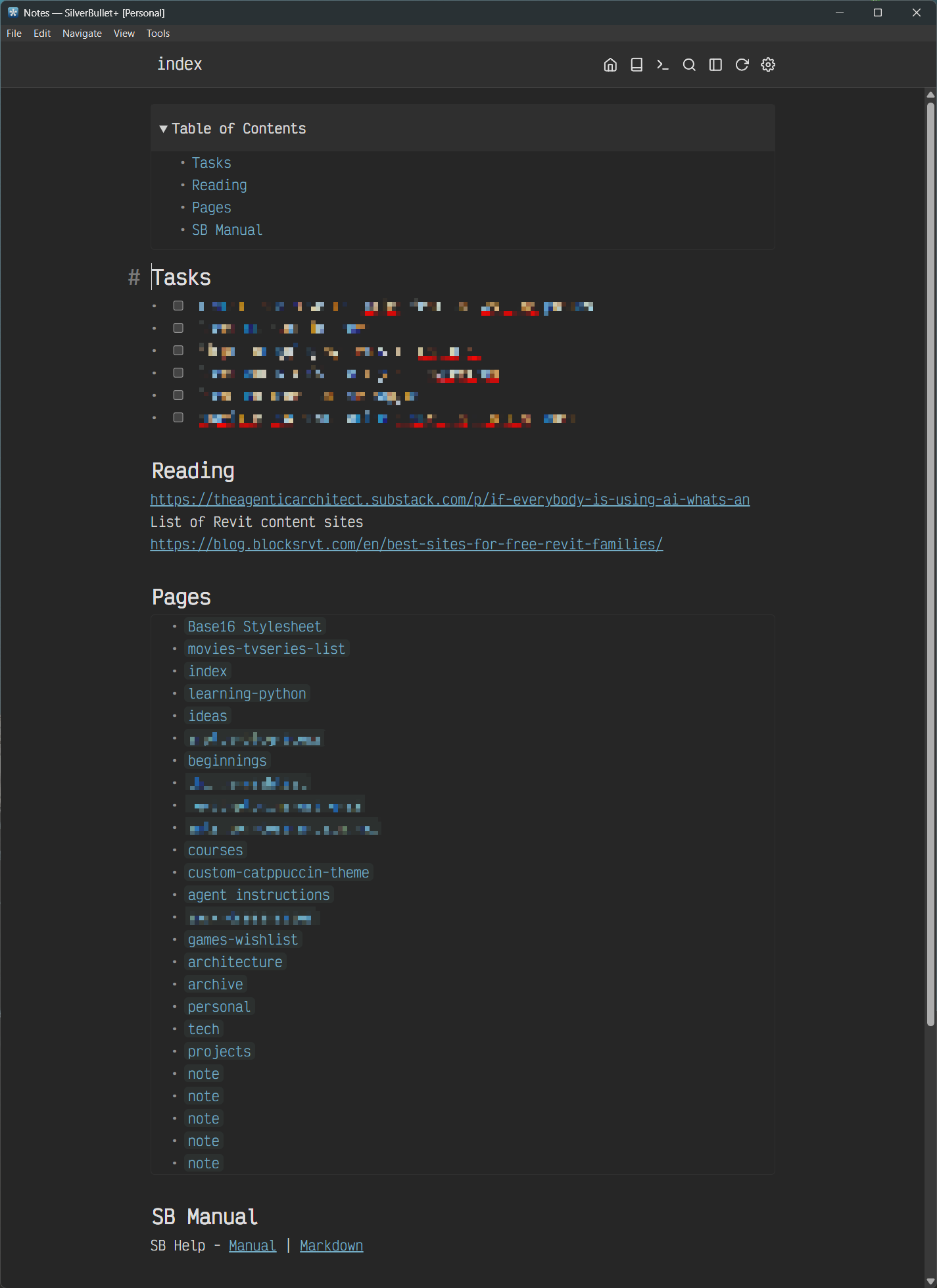
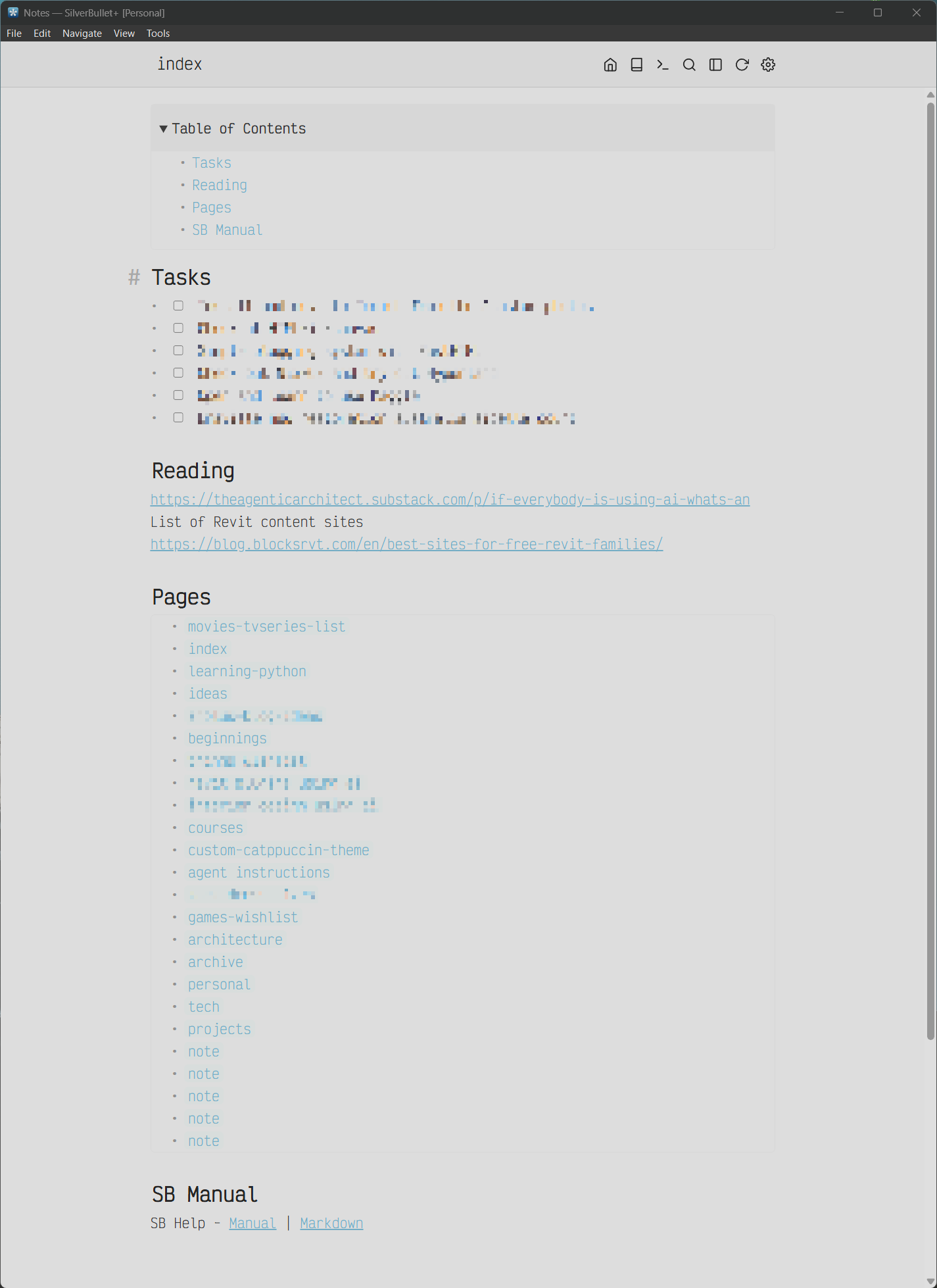
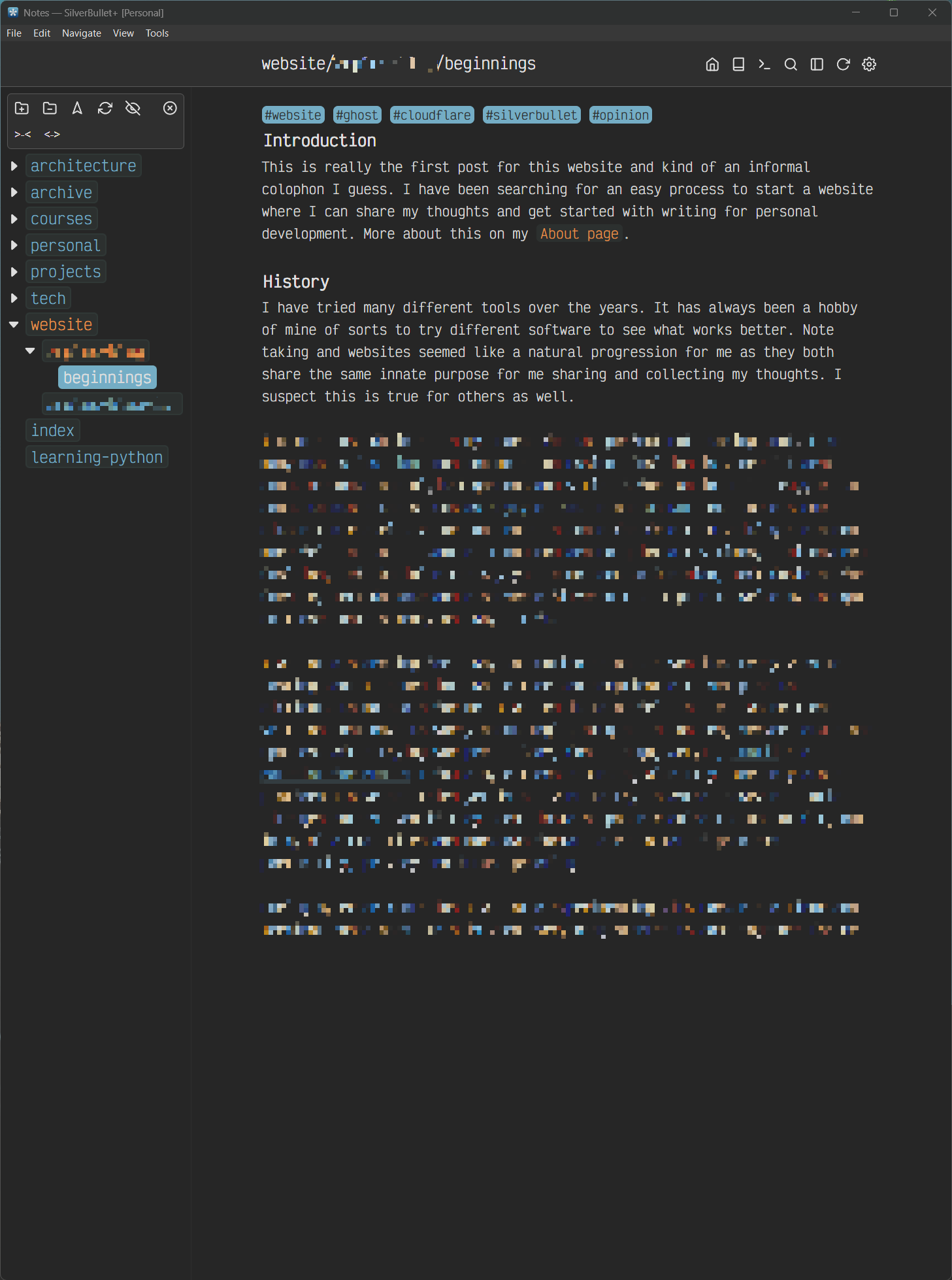
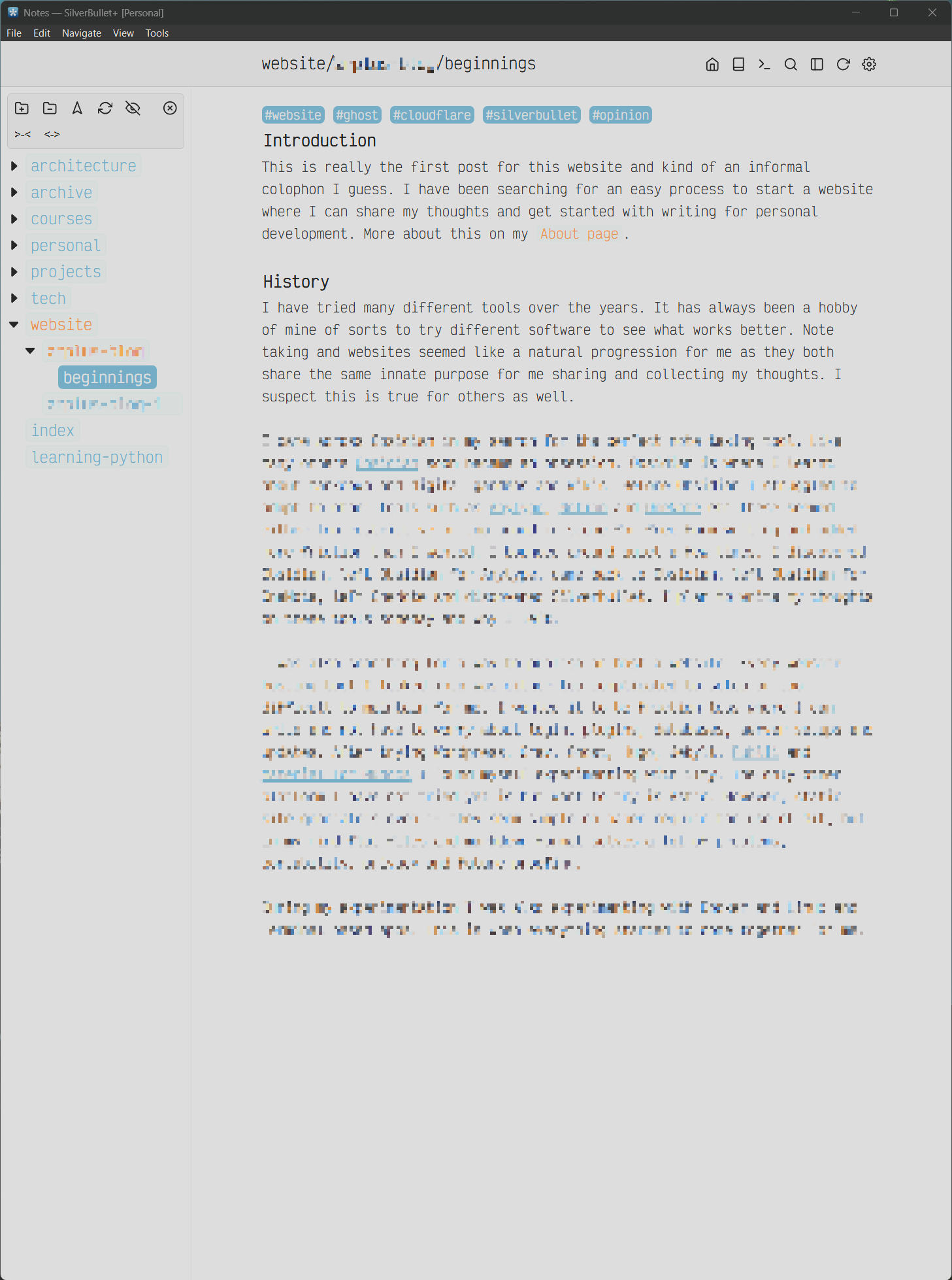
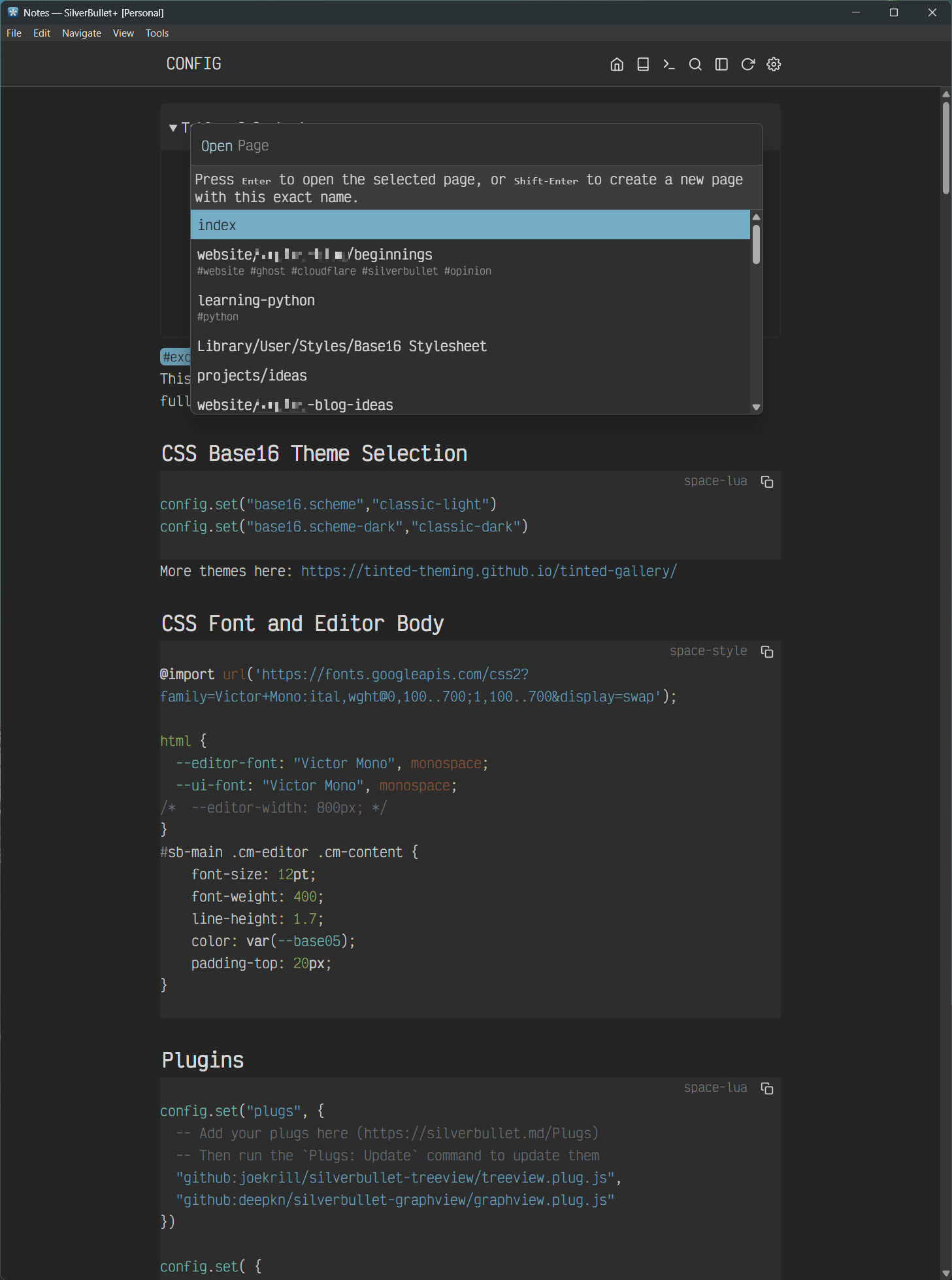
Here are some pictures of my setup:

Plugins I use: TreeView and Silversearch. I have all the official plugins installed but do not use them as much.

Style changes:

  1. Google Fonts "Victor Mono," including some edits to the font size, weight, padding, and line height.
  2. Additional menu bar buttons.
  3. Font size changed for the menu title on the menu bar—previously, I had an auto-hiding top menu bar based on one of Mr. Red’s CSS snippets here: https://community.silverbullet.md/t/auto-hide-menu-bar/3170.
  4. Some minimal styles applied to the borders of the popup modals. Previously, I had hidden the help text for the popup with no border and a Mica-style translucent, blurry background with an appearance animation and some smooth shadows. I also had the popups centered vertically, but it made the popup jarring if the list became too short. It looked amazing, but this effect does not work properly for the Linux version of the SB+ app, so I decided to lose it.
  5. Lastly, I am also using the Base16 theme loader from this post: https://community.silverbullet.md/t/base16-theme-library-update/3218. I had to modify it because the dark theme would not work; I also added some additional colors for the admonitions and a few other things using Claude Code. I also noticed text looks far sharper on a 4K monitor in dark themes than in any light theme.

The reason I reverted some of my styling to be more default is that I noticed SB is still under heavy development, and I actually like most of Zef’s defaults. I am a believer that sane defaults are what make great software great.

Wishlist items:

  1. I love the paragraph or line highlight effect that iA Writer has. I tried to add this using CSS, but without the proper CSS selector for the CodeMirror text style (or whatever it is called), it worked unreliably. I would love to see this feature added or someone making a CSS style that makes this work reliably.
  2. I also love the animated cursor motion in Neovide, but that is asking for too much, as I realize that seems too far-fetched for what SB actually is.
  3. I would also like to see a CSS selector added for the modal close so I can apply a closing effect to all the modals.
  4. Whenever I load SB, there is a split-second transition for the theme to take effect. I realize the priority number to load the CSS might need to be higher, but it still does not work for me.
  5. The ability to hide the top menu bar for distraction-free writing to be a built-in feature.
  6. Lastly, better documentation, especially around space-script and some of the built-in functions. I know this is very hard for a single-person open-source dev to complete, especially with all the continuous updates, but a man can wish.

Thanks :folded_hands: Zef for a wonderful piece of software and a gift to the community. I will try and donate some amount in the near future.